





Arduino
A programmable development board connects code with physical inputs and outputs.
Explore equipment →

SPECTRACORE LEARNING RESOURCES
Discover equipment, understand its role, and plan practical classroom activities.
A programmable development board connects code with physical inputs and outputs.
Explore equipment →A standalone tester produces control pulses for checking a hobby servo before integration.
Explore equipment →A stepper system divides rotation into commanded increments using an external driver.
Explore equipment →A reader identifies nearby compatible tags using radio communication.
Explore equipment →A portable battery pack supplies power through its supported output connectors.
Explore equipment →Several infrared sensing elements measure differences across a surface.
Explore equipment →A microphone module converts changing sound into an electrical signal.
Explore equipment →A flow sensor produces a signal related to liquid passing through its body.
Explore equipment →A colour-sensing module measures aspects of reflected or incident light.
Explore equipment →A force-sensitive element changes its electrical behaviour when pressed.
Explore equipment →A combined sensor provides readings for ambient temperature and moisture in air.
Explore equipment →A temperature-sensing device converts thermal conditions into a readable signal.
Explore equipment →A flexible resistive element changes its resistance as it bends.
Explore equipment →A sensing plate can detect water contacting its conductive surface.
Explore equipment →A touch module detects contact with its sensing surface.
Explore equipment →A soil probe estimates moisture using an electrical measurement.
Explore equipment →A relay lets a control signal operate a separate switching circuit.
Explore equipment →An optical pulse sensor detects changes that may be associated with blood flow.
Explore equipment →A passive infrared module responds to changes in infrared radiation within its field of view.
Explore equipment →An accelerometer reports acceleration along three axes, including the effect of gravity.
Explore equipment →An ultrasonic ranging module estimates distance from the return of a sound pulse.
Explore equipment →An infrared pair can send and detect optical signals over a suitable path.
Explore equipment →Gas-sensitive elements change their response in the presence of certain gases.
Explore equipment →A magnetometer measures magnetic field components along three axes.
Explore equipment →An infrared obstacle module detects reflected light from nearby objects.
Explore equipment →A capacitive touch switch provides a simple touch-sensitive input.
Explore equipment →A capacitive sensing module detects changes caused by a nearby finger or conductive object.
Explore equipment →Push buttons provide user-operated circuit inputs.
Explore equipment →A timer integrated circuit can be configured for timing and oscillation tasks.
Explore equipment →A small motor with an eccentric mass creates vibration.
Explore equipment →An audio playback module stores or plays recorded sound through a suitable output.
Explore equipment →A motor driver supplies controlled current to a motor from a separate power path.
Explore equipment →An active buzzer produces sound when supplied with its specified power.
Explore equipment →A joystick typically combines directional movement sensing with a push input.
Explore equipment →A matrix keypad arranges buttons in rows and columns to reduce wiring.
Explore equipment →A light-dependent resistor circuit responds to illumination.
Explore equipment →A laser module produces a concentrated beam of light.
Explore equipment →A satellite-navigation receiver estimates position when reception conditions permit.
Explore equipment →A compatible cellular module exchanges data over supported mobile networks.
Explore equipment →Segmented LEDs form digits and simple characters.
Explore equipment →A Bluetooth module provides a short-range wireless communication interface.
Explore equipment →A matrix arranges LEDs in rows and columns for small patterns.
Explore equipment →A piezoelectric element converts mechanical deformation into an electrical response and can also vibrate electrically.
Explore equipment →A small pump moves water through tubing when powered within its rating.
Explore equipment →A linear regulator produces a regulated output from a suitable input supply.
Explore equipment →USB cables connect compatible devices for power, data or both depending on their construction.
Explore equipment →A character LCD displays two lines of text using its supported interface.
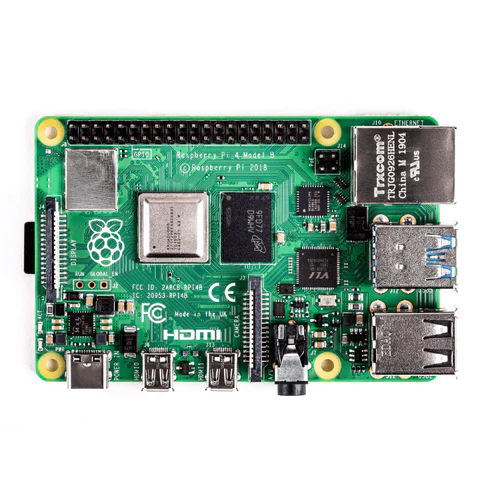
Explore equipment →A single-board computer runs software and interfaces with external hardware through suitable connections.
Explore equipment →A NodeMCU development board supports connected electronics projects; exact capabilities depend on its variant.
Explore equipment →Pin headers provide detachable connections between boards, modules and cables.
Explore equipment →Jumper leads connect compatible pins and breadboard points during prototyping.
Explore equipment →Insulated single-core wire is used for internal circuit connections.
Explore equipment →A battery connector and barrel jack join a compatible battery to a device.
Explore equipment →Spring clips provide temporary electrical connections to exposed conductors.
Explore equipment →A transistor can control current or amplify a signal when correctly biased.
Explore equipment →A diode conducts preferentially in one direction within its operating limits.
Explore equipment →A geared motor trades speed for torque to drive a wheel or mechanism.
Explore equipment →A hobby servo combines a motor, gearing and control electronics for commanded movement.
Explore equipment →A DC motor converts electrical energy into rotary motion.
Explore equipment →Capacitors store electrical charge and are used in timing, filtering and other circuits.
Explore equipment →Resistors limit current and establish voltages in electrical circuits.
Explore equipment →A battery stores chemical energy and supplies electrical power.
Explore equipment →A perforated circuit board supports permanent soldered prototypes.
Explore equipment →A solderless breadboard joins component leads through internal contact strips.
Explore equipment →An RGB LED combines red, green and blue light sources.
Explore equipment →A light-emitting diode produces light when driven with suitable polarity and current limiting.
Explore equipment →Original educational descriptions by Spectracore. This guide is not an official procurement specification or a substitute for model-specific instructions. Package groupings help organise learning resources; confirm current requirements separately.
